
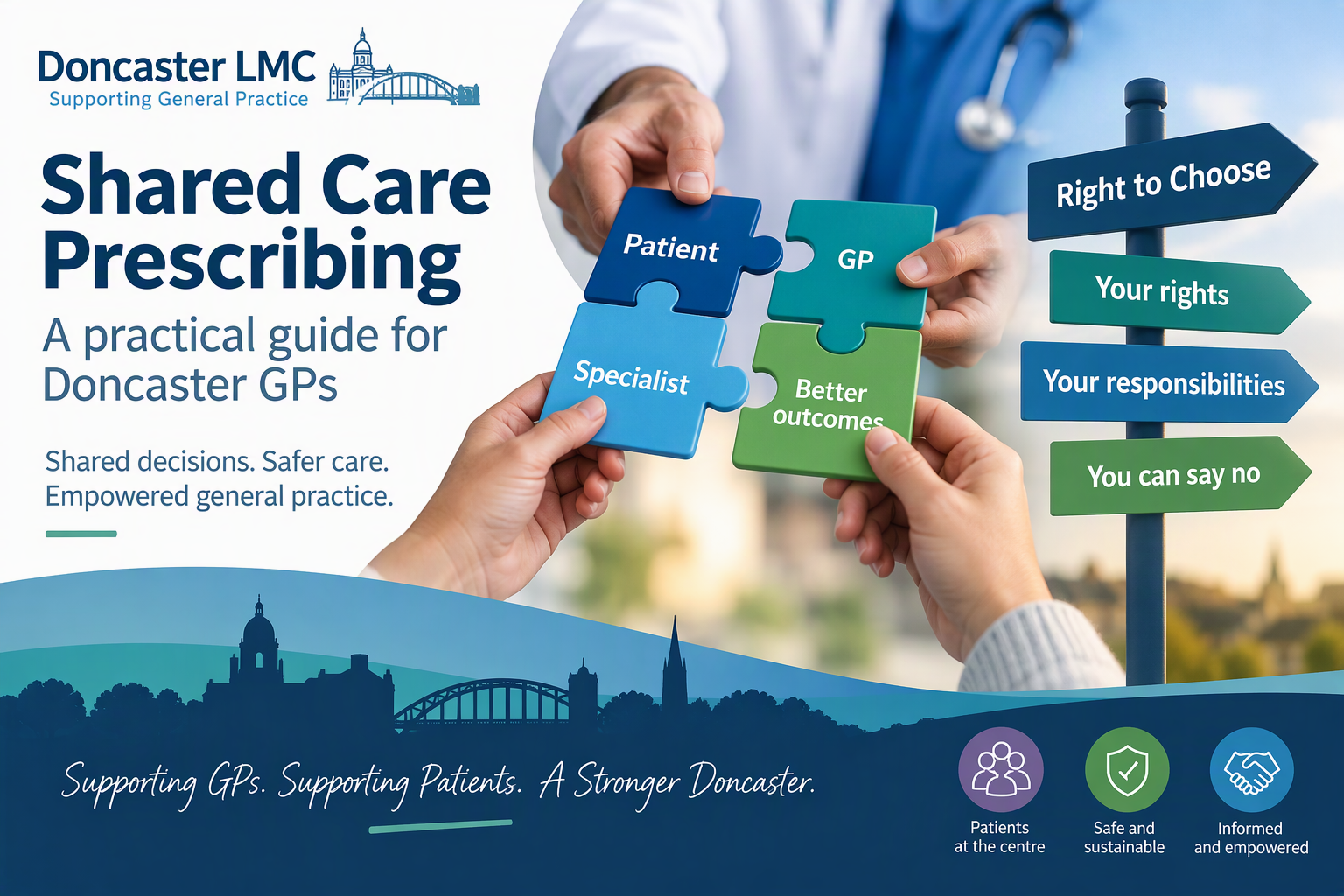
Shared care can help patients receive convenient, coordinated treatment while retaining access to specialist expertise. However, it must be genuinely shared, clinically safe and supported by clear arrangements. It is not simply a mechanism for transferring prescribing, monitoring or risk from a specialist service to general practice.
The central message for practices is straightforward: shared care requires agreement. A GP practice may say no.
Key principle
A specialist may request shared care, but cannot impose it. The decision to accept remains with the GP practice and the individual prescriber.
Shared care prescribing is an arrangement in which a specialist initiates or recommends treatment and responsibility for ongoing prescribing, monitoring and clinical review is divided between the specialist service and the patient’s GP practice.
It should not be confused with:
Shared care requires the agreement of everyone involved, including the patient. The General Medical Council’s shared care standards state that all parties must agree, communicate effectively and work together. The GP must be satisfied that the prescription is necessary, appropriate, within their competence and supported by enough information to prescribe safely. [gmc-uk.org]
The British Medical Association’s Principles for Shared Care Prescribing describes shared care prescribing as non-core voluntary activity which a GP practice may decline for any reason. Examples include insufficient capacity, insufficient competence in relation to the medicine, or inadequate assurance that continuing specialist support will be available. [bma.org.uk]
Practices should therefore reject the idea that they are obliged to accept a request simply because:
NHS England’s Shared Care Protocols expressly state that there is no legal obligation or mandatory requirement to use the national protocols. [england.nhs.uk], [england.nhs.uk]
A protocol may provide a framework for safe care, but it does not compel a practice to participate. Nor does the existence of a protocol determine whether a particular GP has the capacity, competence or supporting infrastructure required to accept responsibility.
A GP who signs a prescription remains professionally responsible for the decision to prescribe. The fact that a specialist recommended the treatment does not transfer that responsibility back to the specialist.
The General Medical Council requires a prescriber acting on another professional’s recommendation to be satisfied that the medicine is needed, appropriate, within the limits of their competence and supported by sufficient information. The prescriber remains responsible for the steps taken to establish that the prescription is appropriate, necessary and safe. [gmc-uk.org]
A GP participating in shared care should be able to:
These are continuing responsibilities, not boxes to be ticked only when shared care is first accepted.
A practice may decide to accept where it is satisfied that the arrangement is safe, properly supported and manageable within its available resources.
Before accepting, consider whether all the following are present.
The proposed agreement should identify:
The responsibility for each task should be explicit. Phrases such as “monitor as appropriate” or “GP to arrange bloods” are not sufficient unless it is also clear who interprets the results, contacts the patient and makes treatment decisions.
The specialist should normally retain responsibility while treatment is initiated and stabilised. The point at which transfer is proposed should be determined by the patient’s clinical position and the relevant agreement, not merely by the passage of time.
The British Medical Association advises that an appropriate stabilisation period should occur before prescribing is handed over and that the duration should be determined by the shared care agreement. [bma.org.uk]
Shared care cannot be safe if the specialist effectively withdraws after asking the GP to prescribe.
There should be:
The British Medical Association identifies enduring specialist input and a mechanism for timely advice as principles of shared care. [bma.org.uk]
A GP should not accept responsibility for work they do not feel competent to undertake safely. Training material or a protocol does not, by itself, establish competence.
The General Medical Council requires doctors to recognise and work within the limits of their competence and to keep relevant prescribing knowledge and skills up to date. [gmc-uk.org], [gmc-uk.org]
Capacity is a legitimate patient-safety consideration. A practice may understand the treatment but still lack the workforce, systems or appointments required to provide the monitoring reliably.
Accepting work that cannot be delivered safely does not help the patient. The practice should consider the effect on both the individual patient and the care available to its wider registered population.
Shared care often creates additional work involving prescribing, tests, recalls, results management, patient communication and clinical review.
The British Medical Association states that additional monitoring work should be delivered through a funded, commissioned pathway. Its current guidance also advises practices to decline new arrangements which lack a locally commissioned formal agreement, adequate resources and clear clinical responsibilities. [bma.org.uk], [bma.org.uk]
A practice may reasonably decline where, for example:
A refusal should be based on defensible principles and applied consistently. The British Medical Association advises practices to frame refusals through an established set of principles so that decisions are not discriminatory towards particular patient groups. [bma.org.uk]
Saying no to shared care does not mean abandoning the patient or opposing their treatment. It means declining a proposed division of responsibility that the practice cannot safely accept.
The practice should:
Avoid simply writing “shared care declined” without an explanation. A clear response is safer for the patient and makes it easier for the provider or commissioner to address the underlying problem.
Suggested wording is:
Thank you for asking the practice to enter into shared care for this patient. We have considered the request but are unable to accept the transfer of prescribing and monitoring responsibility.
Shared care requires the agreement of all parties. On this occasion, the practice is not satisfied that it can undertake the proposed responsibilities safely and sustainably because [insert reasons].
Prescribing and associated monitoring therefore remain the responsibility of the initiating specialist service. This decision does not affect the patient’s registration with the practice or their access to routine general medical services.
The responsibility should not fall into a gap. If the practice does not accept shared care, the initiating or specialist service should continue to prescribe and undertake the monitoring required for its treatment.
Where there is an immediate risk of interruption, the practice should assess the patient’s clinical circumstances and take proportionate steps to prevent avoidable harm. That does not mean the practice must accept an unsafe long-term arrangement. Any exceptional short-term action should be clearly documented, communicated to the specialist and not allowed to become an assumed permanent transfer.
Concerns about the design or commissioning of the pathway should be raised with the relevant commissioner and Doncaster LMC. Persistent attempts to transfer responsibility without agreement should be documented.
Shared Care
Right to Choose and shared care: guidance for GPs
May 2025 Update
Welcome to Doncaster LMC. We use cookies to enhance your experience, analyse site traffic, and personalise content. By clicking 'Accept,' you consent to our use of cookies. You can manage your cookie preferences or withdraw consent at any time by adjusting your settings. For more details, please review our Cookie Policy Learn more