


Skip to content
email-marketing-gb64593361_1920

March 2026 Update

Insulin Adjustment for Diabetes - LMC Position

Dear Colleagues,

Doncaster LMC has reviewed the recent communication regarding proposed changes to the diabetes specialist nursing service, including the expectation that general practice may assume responsibility for insulin adjustment in people with diabetes. The letter explicitly references a “process in primary care… when patients need insulin adjustments” and a “step down from DSN team to primary care once ready for discharge.” These statements indicate a shift of insulin titration into routine general practice.

Following discussion at the full LMC meeting, we want to be clear that this work does not sit within the core GP contract, and any shift of insulin titration or modification into primary care represents a significant transfer of workload, clinical risk, and liability to practices. Insulin management requires specialist expertise, carries significant clinical risk, and is not resourced within existing contractual arrangements.

At this stage:

  • We do not support the transfer of insulin adjustment responsibilities into general practice.
  • We do not support publication or implementation of any communication that implies such a shift, until contractual, indemnity, training, and workload implications have been formally addressed.
  • We have requested clarity from RDaSH and the ICB regarding the intended scope of the proposal and the support that would be required were any change to be considered.

Practices should continue to provide care in line with the existing GP contract and refer patients requiring insulin modification to specialist services as usual.

We will update you as soon as further information is available.

Contract Summary 2026/27

NHS England has confirmed the final GP contract arrangements for 2026/27. The package focuses on GP capacity, same‑day access for clinically urgent needs, QOF reform, vaccination changes, and new data and engagement requirements.

For further information please follow this link on the Doncaster LMC website https://www.doncasterlmc.co.uk/gp-contract-summary-2026-27

Updated Fibroscan Referral Forms Now Live for Doncaster Practices.

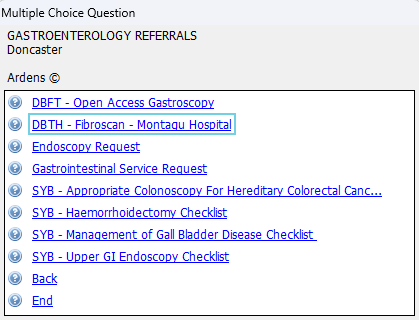
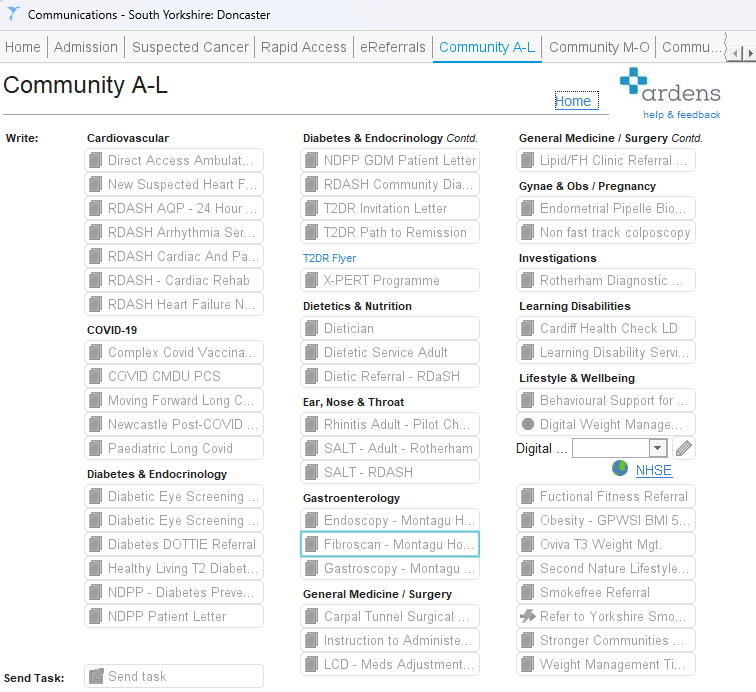
Directs access Fibroscan referral forms for Montagu Hospital have now been added to e-systems for all Doncaster practices. These updates will go live across all EMIS sites within the next week, with SystmOne already updated.

Where to find the new forms

Practices can now access the referral forms in the following locations:

  • EMIS: DBTH – Fibroscan –  Montagu Hospital
  • SystmOne: Fibroscan – Montagu Hospital

Support with locating the forms

Guidance is available for anyone who needs a reminder on how to access referral documents using the F12 key.
Click here to view the step‑by‑step instructions.

What this means for practices

These updates ensure that all Doncaster practices are using the most current referral pathway for Fibroscan services delivered at Montagu Hospital. This supports:

  • Consistent referral quality across the system
  • Reduced administrative delays
  • Clearer routing for DBTH clinical teams
  • Improved patient flow into liver assessment services

Is Your GP Surgery property in order?

The following information has been supplied by Kirsten Brown from VWV.

Is the legal title to the property in the full legal names of current partners?

GP Partnerships cannot register their legal title to a property at the Land Registry in the name of the Partnership. They must therefore name between 2 – 4 individual partners who hold the legal title to the Property on trust for the Partnership.

It is important that this is kept up to date with any partnership changes as keeping retired partners on your property documents can present difficulties in dealing with the property in the future (e.g. if you were to grant a lease or sell the property and were no longer in contact with a former partner).

Is your Partnership Agreement up to date?

Your Partnership Agreement should be kept up to date with details of your properties and any agreements reached between the partners on how the properties will be held and managed.

Have you informed your Bank of any departures or new joiners in the Partnership?

Most GP Surgery premises will be subject to a legal mortgage. The Bank will need to be kept informed of any changes in the Partnership to ensure their loan and mortgage documentation is up to date and in the names of current partners.

Is your buildings insurance correct?

Your buildings insurance should:

  1. Name the current partners named on the legal title as the insured persons and not the Partnership
  2. Include appropriate reinstatement cover (i.e. your insurance policy should cover the full reinstatement value of your premises, not the market value)
  3. Have the names of the other partners endorsed on the policy
  4. Include cover for a minimum of three years loss of rent insurance to cover any leases in place at the property to third parties.

Do you have a ‘Display Energy Performance’ (DEC) certificate and is it on display in the surgery premises and is the rating at least level ‘E’?

A DEC is required for any building that is larger than 250 square meters and is occupied by a public authority, this includes GP surgeries.

The DEC must be displayed openly for the public to see at the property.

Do you have an asbestos report to show that you have identified and are managing any asbestos risks at the Property?

Many GP Surgeries were developed at a time when asbestos was still commonly used. Unless the premises is fairly modern, there should be an asbestos report in place and the Partnership should be managing the risks identified in accordance with the report’s findings and recommendations.

Do you have the required risk assessments in place?

A GP Surgery should have the following risk assessments in place which are kept under regular review and should manage any risks identified accordingly:

  1. A fire risk assessment
  2. A legionella’s assessment
  3. An equality act risk assessment.

If you are a tenant of your premises, have your rent reviews been carried out and properly documented?

Many GPs lease their surgery premises. GP Surgery leases usually provide for rent reviews to be undertaken every 3 years. It is important to ensure that rent reviews are undertaken in a timely fashion and are properly documented to avoid outstanding reviews (and subsequent outstanding rent payments) accumulating.

Are any third parties who regularly use space in the property properly documented (a licence or lease arrangement)?

It is common for GPs to share use of their premises with other healthcare providers without any formal documentation being in place. It is important that such agreements are documented to ensure that any third parties who use your premises do not gain any unintended rights over the premises.

Are the rent reviews up to date in any Leases to third party occupiers?

It is common for GPs to grant leases to third parties, such as dentists or pharmacies. It is important to ensure that these leases are properly managed and, in particular, that the rent reviews due under these leases are undertaken as they fall due and are properly documented. 

Are you recovering all the financial contributions you are entitled to from occupational tenants? For example, insurance/service charges/rates?

Many GPs Surgeries are shared with third parties, such as other healthcare providers, pharmacies and dentists, who may have an obligation under their leases to contribute towards the cost of items such as insurance, utilities, rates and services. You should ensure that you are collecting the contributions which you are entitled to. 

Have any occupational leases or licence arrangements expired? Or are any about to expire?

If you lease a GP Surgery, or have granted a lease or licence to a third party (e.g. a pharmacy), it is important to keep an eye on the expiry date of that lease or licence to ensure that it is renewed before it’s expiry.

If you would like more information please contact Kirsten Brown in the Healthcare Commercial Property team. VWV solicitors.

National flu immunisation programme plan 2026 to 2027

The national flu vaccination programme letter for 2026 – 2027 has now been published, setting out the eligibility criteria, programme timings, and vaccine recommendations for the upcoming autumn/winter season. The guidance is aimed at all organisations responsible for commissioning and delivering the NHS seasonal flu programme in England.

Why this matters

Winter remains the period of highest pressure on health and care services, with respiratory viruses peaking and placing significant strain on urgent care, primary care, and community services. The national letter emphasises that increasing vaccination uptake across all eligible cohorts is essential to protect the most vulnerable and maintain system resilience.

Eligibility for 2026-2027

There are no changes to the eligible cohorts for this season. Eligibility continues to follow Joint Committee on Vaccination and Immunisation (JCVI) advice.

From 1 September 2026

  • Pregnant women
  • Children aged 2 or 3 years on 31 August 2026
  • Primary and secondary school-aged children (Reception to Year 11)
  • Children aged 6 months to under 18 years in clinical risk groups

From 1 October 2026

  • Adults aged 65 years and over
  • Adults aged 18 to under 65 years in clinical risk groups
  • Residents of long-stay residential care homes
  • Carers (including those in receipt of carer’s allowance or acting as the main carer for an elderly or disabled person)
  • Close contacts of immunocompromised individuals
  • Frontline social care workers without access to employer-led occupational health schemes
  • All frontline health care workers, clinical and non-clinical, who have direct patient contact

Employers are expected to ensure easy access to vaccination for all eligible frontline staff and to monitor uptake.

Programme Timing and Delivery Expectations

  • Pregnant women can be vaccinated from 1 September 2026.
  • All other adult cohorts begin from 1 October 2026.
  • Most vaccinations should be completed by end of November 2026, though delivery can continue until 31 March 2027 for eligible groups.

Vaccine Recommendations for 2026-2027

JCVI has reviewed the latest evidence and confirmed that all preferred vaccines for this season are trivalent. Key updates include:

  • For adults aged 65+, cell-cultured vaccine (IIVc) is considered equivalent to adjuvanted (aIIV), high-dose (IIV-HD), and recombinant (IIVr) vaccines.
  • For adults aged 50–59 in clinical risk groups, IIV-HD may be used off-label.
  • Egg-cultured vaccine (IIVe) should only be used for adults under 65 when preferred vaccines are unavailable.

Commissioners will actively recover payments where incorrect vaccines are used for a cohort.

What this means for practices and PCNs

  • Early planning is essential particularly around workforce, clinics, and coordination with school-aged immunisation teams.
  • Maximising uptake across all eligible groups remains a national priority, with a clear expectation of year-on-year improvement.
  • Data quality and timely reporting will continue to be critical for system oversight and reimbursement.
  • Collaboration across neighbourhoods and providers is strongly encouraged to ensure consistent access and reduce variation.

Transfer of direct commissioning functions

NHS England has now confirmed its intention to transfer all remaining direct commissioning functions to Integrated Care Boards (ICBs) from April 2027, subject to the required legislative changes. This marks the next major step in establishing ICBs as the strategic commissioners for almost all NHS services, with only the most highly specialised areas remaining nationally commissioned.

What the national letter sets out

The letter provides a clear roadmap for the transition and describes the leadership role expected of ICBs throughout 2026/27, ahead of the formal transfer. It also introduces the creation of seven Offices for Pan‑ICB Commissioning (OPICs) – regional hubs designed to support commissioning at scale, strengthen expertise, and ensure consistency across systems.

These OPICs will be hosted by one ICB in each region and will bring together the specialist commissioning workforce currently based in NHS England’s regional teams. They are expected to be fully operational by April 2027.

Commissioning functions transferring to ICBs from April 2027

Subject to parliamentary approval, the following services will move from NHS England to ICBs:

  • Vaccinations, Child Health Information Services (CHIS), and almost all screening services
  • Health and Justice services, and sexual assault and abuse services, including Sexual Assault Referral Centres (SARCs)
  • Specified specialised services, including all previously delegated services and a small number of additional services deemed suitable for ICB commissioning
  • Primary care services, including all previously delegated functions

This represents a significant expansion of ICB responsibility, building on the earlier delegation of primary care commissioning in 2022 and 2023.

What remains nationally commissioned

Once NHS England is abolished (expected in 2027), the Department of Health and Social Care (DHSC) will take on responsibility for:

  • Highly specialised services, including high‑secure mental health services
  • A small number of specialised services not suitable for ICB commissioning
  • National reimbursement of high‑cost tariff‑excluded drugs and devices
  • Armed forces community services currently commissioned nationally
  • Certain nationally commissioned components of screening programmes

DHSC will also maintain national service specifications, standards, and clinical commissioning policies to ensure consistency.

Expectations for 2026/27

ICBs are expected to:

  • Lead commissioning of the services listed above from April 2026, even though legal accountability remains with NHS England until 2027
  • Strengthen joint governance arrangements already in place for delegated specialised services
  • Work with regional teams to understand population footprints and identify where multi‑ICB collaboration is required
  • Prepare to host or work with their regional OPIC to ensure commissioning capacity and capability is in place at scale

This transition year is intended to ensure a smooth handover and avoid disruption to service delivery.

CQRS: Reminder - QOF 25/26 Manual Indicators

Please be reminded that practices are required to submit data for the six Quality Improvement (QI) indicators (highlighted below) in the Quality and Outcomes Framework (QOF) 2025/26 service.

This data is required to be submitted in order for CQRS to calculate an achievement for the QOF 2025/26 service. If practices do not provide the required information for these QI indicators by end of day (EOD) on 1st April 2026, QOF 25/26 achievement will not calculate at year-end due to missing data and calculation will be delayed until entered.

Please follow the steps below to submit manual data for the QI indicators in CQRS:

  • Go to the Data submission tab
  • Ensure the financial yearis set to 25/26
  • Select the QOF 25/26service
  • From the drop-down menu, select the achievement date: 31/03/2026
  • Click on Add new achievement
  • On the list of indicators page, scroll to the bottom and select the ‘Quality Improvement’ domain
  • Enter the required values in the appropriate boxes
  • Click submit achievement data

N.B As these QI indicators are noted as being retired from the Quality and Outcomes Framework 25/26, submitted responses will not be subject to review, however a response is still required for a successful achievement calculation.

Please note that if you are one of the small number of organisations that require manual entry for all indicators, please ensure this is done by EOD 1st April 2026.

Please see QI indicator descriptions for your information below:

QI Indicators

Indicator

Description

QI013

The contractor can demonstrate continuous quality improvement activity focused upon workforce and wellbeing as specified in the QOF guidance 

QI014

The contractor has participated in network activity to regularly share and discuss learning from quality improvement activity focused on workforce and wellbeing as specified in current QOF guidance. This would entail attending two primary care network meetings, at the start and towards the end of QI activity. If a practice is not within a PCN, the expectation is that two meetings would be held locally with other practices

QI016

The contractor can demonstrate that it has in place a recognised and validated approach to understanding demand/activity, capacity and appointment data and has made improvements to data quality to better reflect practice work.

QI017

The contractor can demonstrate that it has utilised demand and capacity data to inform operational decisions and plan for demand and capacity matching 

QI018

The contractor has participated in network activity to review the smart cards of all staff employed under the Additional Roles Reimbursement Scheme (ARRS), to ensure that the staff role assigned on their smart card aligns with the role they are employed under within the ARRS.

QI019

The contractor can demonstrate improvement in reducing avoidable appointments by 
1. Using BI tools, if available and practice collected data where not, to understand the practice activity including variations over the days of the week, time of day and time of year.
2. Developing an understanding of the telephone queue either by extracting data from their cloud-based telephony system or asking staff to collect data over a period.
3. Using that data to understand their peaks of activity and better matching their capacity to their demand by, for instance, reviewing rotas.
4. Using improvement techniques described in the Primary Care Transformation Team’s webinar series on Demand and Capacity which provides practical advice and guidance.
5. Referencing the Royal College of General Practitioner’s 6 steps to start to improve delivering continuity of care from their Continuity Toolkit for those who need it and adapting to suit the needs of the practice.

Doncaster & Bassetlaw MO Bulletin February 2026

Powered By EmbedPress

Tirzepatide in adults 18 years and over with type 2 diabetes mellitus

Tirzepatide (Mounjaro®) Kwikpen in adults 18 years and over with type 2 diabetes mellitus, amber G guidance document V2.0 has been updated and approved at the IMOC meeting .  The update included an update to the pancreatitis, orlistat and retinopathy sections and addition of the flow chart from PCDS as an appendix. 

Powered By EmbedPress

The SY Gluten Free Prescribing position statement

The SY Gluten Free Prescribing position statement is now live on the medicines Optimisation website. 

SYICB does not recommend the routine prescribing of gluten free food products for use in coeliac disease, confirmed gluten-sensitive enteropathies and dermatitis herpetiformis or other gluten intolerances in South Yorkshire. SY IMOC Traffic Light Status: GREY (gluten free products should not be prescribed in South Yorkshire unless exceptional circumstances apply).

Powered By EmbedPress

Simpler Recycling in England

From March 2025, new Simpler Recycling requirements will apply across England. These changes affect general practice premises and other primary care sites as “relevant non-domestic premises”. Please follow this link to the Doncaster LMC website for further information regarding what practices need to know, what is changing, and the practical steps to take. https://www.doncasterlmc.co.uk/simpler-recycling-in-england

GP Partner Launchpad: Applications Open for 2026/27 Cohort

Are you a new or aspiring partner (GP or non-GP) in South Yorkshire looking to thrive in your role?

The GP Partner Launchpad is designed to unlock your potential, empower you to lead change, and equip you with the essential business and leadership skills needed for a successful career in partnership.

What the scheme covers:

  • Business Skills: Practice finances, accounts (with BHP Chartered Accountants), contracts, and estates management.
  • Leadership & People: Handling HR issues, managing team dynamics, and resolving partnership conflict.
  • Wellbeing: Managing workload and building resilience (with experts from Resilient Practice).
  • Local Context: Understanding the roles of the LMC, GPC, and BMA.
  • We also aim to support the development of a community of practice whereby participants are able to give mutual support and build a network of peers that will support your career for years to come

Delivered by:
Education leads from the SY Workforce & Training Hub, SY LMC Executives, and other experts.                                   

Join the 2026/27 Cohort:
Please express your interest by the end of May.

Register your interest here: https://yhtraininghubs.co.uk/south-yorkshire/south-yorkshire-schemes/gp-partner-launchpad/

Eating Disorder Provision for Doncaster Adult Patients

Under 18s

Refer to RDaSH CAMHS services

Referral Process Information: Child and adolescent eating disorders – Rotherham Doncaster and South Humber NHS Foundation Trust (RDaSH)

Over 18s

SYEDA

Accept presentations of Binge Eating Disorder and mild / moderate presentations of Anorexia Nervosa (BMI over 17.5) and Bulimia Nervosa (frequency of purging less than x 5 a week) where there are no significant broader MH concerns. Young persons with ARFID who are under the age of 25 with a BMI of over 17.5.

Referral Process Information: SYEDA – South Yorkshire Eating Disorder Association

Doncaster CMHT

Where there are significant broader mental health concerns (reaching the threshold of CMHT support) alongside eating disorder presentation; specialist clinicians are available within the Doncaster CMHT provision.

Referral Process Information: Adult community mental health – Rotherham Doncaster and South Humber NHS Foundation Trust (RDaSH)

Specialist Eating Disorders Service (SEDS)

SEDS – Accept moderate / severe presentations of Anorexia Nervosa (BMI under 17.5 / rapid weight loss) and Bulimia Nervosa (frequency of purging more than x 5 a week) and patients where there are additional risk factors (e.g. pregnancy / poorly managed diabetes) and patients who are transferring from another specialist eating disorder service.

Copies of required blood tests need to be sent with the referral form for triaging (currently SEDS can not access ICE results for Doncaster patients).

Referral Process Information: Eating Disorder Service | Sheffield Partnership University NHS Foundation Trust

Currently there are very limited commissioned services for ARFID in the SY region. ARFID presentations that meet SYEDA acceptance criteria and are under the age of 25 can be assessed for suitability for a pathway offered by  SYEDA – South Yorkshire Eating Disorder Association

LMC Buying Group

Doncaster LMC is been a member of the LMC Buying Groups Federation.

Buying Group membership entitles practices to discounts on products and services provided by the Buying Group’s suppliers.

Membership is free and there is no obligation on practices to use all the suppliers. However, practices can save thousands of pounds a year just by switching to Buying Group suppliers. To view the pricing and discounts on offer you need to register for access to the Buying Group’s online portal: https://buying.plexusportal.co.uk/Register.

What is the purpose of the Buying Group and how does it work?

The sole purpose of the Buying Group is to save its member practices money by negotiating discounts on goods and services which practices regularly purchase. The Buying Group team negotiate with suppliers, after which they identify ‘approved’ suppliers, who guarantee to give you significant discounts over what you would otherwise pay for their services, in return for the Buying Group’s endorsement and help in making you aware of what they offer.

Does it cost us anything to be part of the group?

No, membership is free and members are free to use as many discounts as they wish.

Is there any obligation to take up the deals offered?

No. Each practice is free to take up or decline any of the deals the Buying Group have negotiated. If you wish to take advantage of any of the offers in question, you will be given contact details, and all communications take place between you and the individual supplier*.

*The Buying Group accepts no liability for any contract willingly entered into by a practice with an approved supplier. Practices are advised to check that the terms of any contract with suppliers are consistent with those the Buying Group have negotiated and are advised to inform the Buying Group team of any discrepancy. The Buying Group do not, however, accept any responsibility for any member practices’ failure to check the terms of the relevant contract and the principle of caveat emptor (buyer beware) applies in all cases. Your rights as a consumer under the Consumer Protection Act are unaffected. With respect to any services to which the provisions of the Financial Services Act 2000 might apply practices are advised to seek independent financial advice as may be appropriate.

What happens to my details?

When a practice signs up for Buying Group membership, they will keep your basic contact details (practice address) on a secure system. On the membership application form, they also ask you how they can use your personal data (i.e. your email address) but even if you do sign up to receive their emails you can stop them at any time by clicking the unsubscribe button.

What if I am not happy with the quality of goods and services supplied?

Always let the Buying Group know if you encounter any problems getting what you want, and they will endeavour to sort it out.

Contact the Buying Group

The Buying Group is managed by Plexus Support Services Ltd:

Tel: 0115 979 6910

Email: info@plexussupport.co.uk

Website: https://www.plexussupport.co.uk

Call Now Button